
By Liam McCollum
At the bottom of this article is a list of veterans, Republican legislators, and influential libertarians who have joined as a coalition and signed on to this article
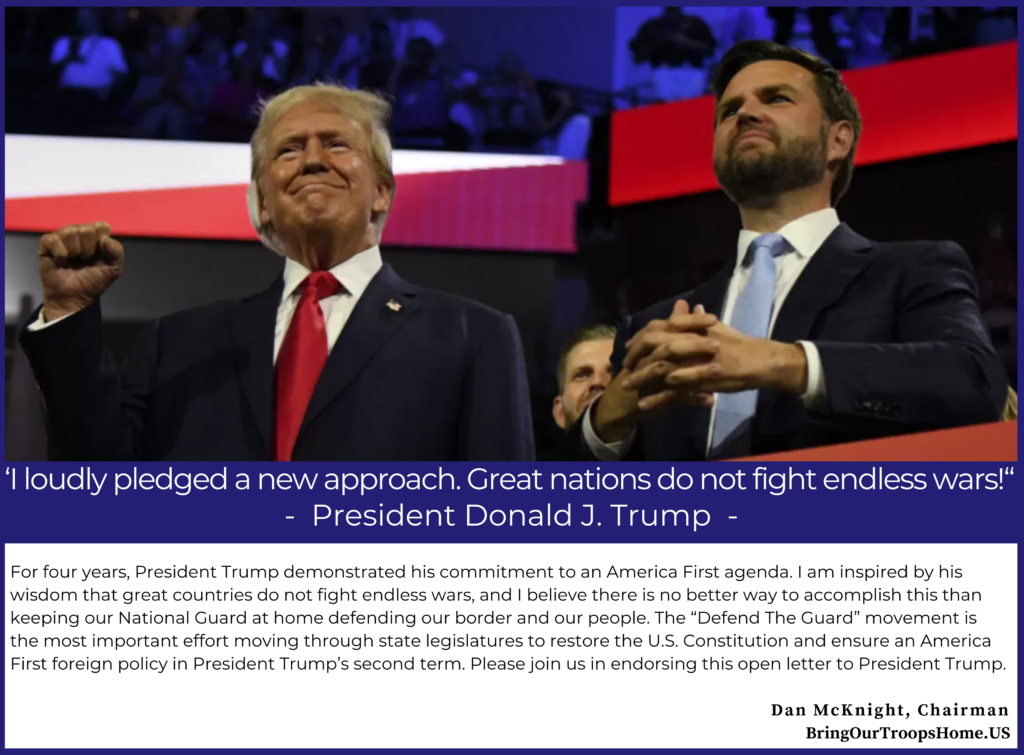
The newly adopted Republican Party platform promises to “SEAL THE BORDER” and “PREVENT WORLD WAR THREE.” Donald Trump, who officially became the Republican Party nominee this week, should endorse the Defend the Guard Act as a way to achieve both.
The Defend the Guard Act is state-based legislation that would prevent the deployment of National Guard units overseas to foreign wars if Congress has not first formally declared war as the Constitution requires.
Despite commonly being dismissed as “weekend warriors,” the National Guard has been a primary fighting force in the Global War on Terror. Forty-five percent (45%) of those deployed in the post-9/11 wars have been Guardsmen, and Guardsmen have also represented nearly twenty percent (20%) of the casualties from those wars.
My father’s childhood friend was deployed with the North Dakota National Guard when he was killed in action in Afghanistan in 2012. The North Dakota National Guard would not have been in Afghanistan if the Defend the Guard Act had been law in North Dakota and if states had insisted that Congress declare war first.
Lamentably, in addition to their tremendous cost, none of the post-9/11 wars have been constitutional. In fact, Congress has not declared war as required by Article I, Section 8 of the United States Constitution since World War II, and yet, the United States has intervened in countless overseas conflicts since then.
An Authorization for the Use of Military Force (AUMF) is not a declaration of war, but rather, represents Congress’ abdication of their authority and responsibility to declare war to the president—a situation the framers of the Constitution attempted to prevent.
The result has been an asymmetry between foreign policy outcomes and the public’s wishes, and at great cost to the military and the men and women who loyally serve in it.
The American public has consistently favored withdrawal from our endless wars while their government in DC has prolonged them. For instance, the public has repeatedly favored withdrawal from Syria, but famously, top generals lied to President Donald Trump when he attempted to leave.
In addition, nearly three-fourths of veterans supported leaving Afghanistan when President Trump negotiated the original Doha agreement, but the Joe Biden Administration recklessly pushed the withdrawal date from May to the middle of “fighting season,” leading to predictable disaster.
The Defend the Guard Act would have prohibited National Guard units from being sent to any of those conflicts unless Congress, on behalf of the public, went on record first.
An additional consequence of Congress’ abdication is that the National Guard has been fighting endless wars when they could have been deployed at the southern border or at home to protect their communities from natural disasters.
When Hurricane Katrina hit New Orleans, 3,200 Louisiana Guardsmen were overseas in Iraq. When Florida was recently hit by hurricanes, 165 members of the Florida National Guard were training Ukrainians. Earlier this year, Arizona National Guardsmen were injured in a drone strike that killed three U.S. troops on the Jordan-Syria border when they could have been assisting Texas in its efforts at the United States border with Mexico.
The above examples prove that if Donald Trump backed the Defend the Guard Act, it would be consistent with his “America First” messaging and popular with his base of constitutional conservatives.
After Governor Greg Abbott sparred with President Biden over the Texas National Guard and the border earlier this year, the Texas GOP voted internally on the following Republican proposition:
“The Texas Legislature should prohibit the deployment of the Texas National Guard to a foreign conflict unless Congress first formally declares war.”
An overwhelming eighty-four percent (84%) supported the proposition, totaling more than 1.8 million votes.
In addition to grassroots support, the legislation has been endorsed by Vivek Ramaswamy, Tulsi Gabbard, Congressman Paul Gosar, Rand Paul, Ron Paul, and, of course, all of the signatories below.
After a monumental vote in the New Hampshire House of Representatives, which is the second-largest legislative chamber in the United States behind Congress, a Fox & Friends panel hosted by Will Cain, Pete Hegseth, and Kayleigh McEnany expressed resounding support for the legislation. “To me, it makes a lot of sense, and I spent most of my career as a National Guardsman,” Hegseth said, adding, “I love it.” McEnany added, “I love it, too.”
When I asked Congressman Thomas Massie about the effort, he said, “Trump should commit to respecting all aspects of Congress’s sole authority to declare war. This includes all branches of the military as well as the Guard.”
The legislation is also tripartisan, and Donald Trump’s support would likely win over many independents and libertarians to his campaign.
This month, the Montana Republican Party became the sixth state GOP party to adopt Defend the Guard language in its platform. To this day, the bill has been championed in over thirty states by Republican and Democrat sponsors and cosponsors (over a quarter of them military veterans) with the Libertarian Party National Committee’s endorsement and the help of many Libertarian Party state affiliates.
“My goal over the next year is to gain support for this bill from prominent liberty-minded congressmen and senators, like Matt Gaetz and Mike Lee,” Angela McArdle, Chair of the Libertarian Party National Committee, said. “I think a libertarian populist wave is sweeping the nation and people are very open to the idea of bringing our troops home.”
In an effort to win over Libertarian votes, Donald Trump pledged to commute Ross Ulbricht’s sentence and put a Libertarian in his cabinet at the Libertarian Party National Convention in May. Endorsing the Defend the Guard Act is one more thing he can do to persuade Libertarians since it has been one of the party’s primary issue-coalition efforts.
I suspect that Trump’s endorsement would also win over many “small-L” libertarians. The libertarian group “Being Libertarian,” which has over 500k followers across all media platforms, ran a poll on X asking whether libertarians would vote for Trump if he publicly encouraged state governments to pass the Defend the Guard Act, if he supported Rep. Massie’s or Sen. Mike Lee’s “End the Fed” legislation, and if he pledged to pardon Julian Assange, and 86% said yes.
An endorsement of the movement is low-cost to Trump since it is state legislation, and it also builds trust. Trump does not have to actually sign the bill into law himself. For Libertarians who are worried that Trump may not follow through with his other pledges to free Ross or put a Libertarian in his cabinet, an endorsement of state legislation is low-hanging fruit that would instantly put the legislation on the map and push these bills over the edge in many red states.
Libertarians and “America First” conservatives have been waiting for Congress to repeal the 2001 AUMF for years, but only nine U.S. Senators voted for Rand Paul’s recent attempt to do so. Matt Gaetz’s war power resolutions received a similar result; his resolution to direct President Biden to remove troops from Syria only received 102 votes.
At the Libertarian Party National Convention, Donald Trump said, “I will return power to the states, local governments, and to the American people.” The Defend the Guard Act allows the states to insist that Congress do its job and return the decision to go to war back to the people.
As nineteenth-century United States Secretary of State Daniel Webster said, “It will be the solemn duty of the state governments to protect their own authority over their own militia and to interpose between their citizens and arbitrary power.”
Donald Trump should endorse the Defend the Guard movement and defend his support on these grounds: To appeal to Libertarians, he can say that he is “America First” and is opposed to wars that have not been declared by Congress under Article 1, Section 8, Clause 11. To appeal to Republicans, he can say he believes the National Guard should be used for its constitutionally prescribed function under Article 1 Section 8, Clause 15 at the border to stop an “invasion” instead of being engaged in endless wars.
If re-elected, Trump has an opportunity to alter the course of American history for the better and prevent the United States government from becoming the centralized empire that the Founders feared.
National voices:
- Dan McKnight, USMC, US Army, and Idaho National Guard, GWOT veteran, and Chairman of BringOurTroopsHome.us
- Diego Rivera, US Army, GWOT veteran, and Director of Field Operations at BringOurTroopsHome.us
- Ron Paul, former US Congressman and host of the Ron Paul Liberty Report
- Robert F. Kennedy Jr- Candidate for President of the United States
- Joe Kent, U.S. Army Special Forces, GWOT veteran, former CIA Operative, President Trump foreign policy advisor, Republican candidate for United States Congress in Washington’s 3rd District
- Dave Smith, Host of Part of the Problem
- Angela McArdle, Chair of the Libertarian Party National Committee
- Scott Horton, Director of the Libertarian Institute
- Clint Russell, Host of Liberty Lockdown
- Josie Glabach, “The Redheaded Libertarian” and Timcast “X Spaces” Host
- Dave Decamp, Host of Antiwar News
- Michael Boldin, founder of The Tenth Amendment Center
- Michael Heise, founder of the Libertarian Party Mises Caucus
- Chip Slate, President of Being Libertarian
- Dave Van Englehoven, Lead Digital Media Specialist at Being Libertarian
- Mat Blankenship, Chief Content Officer at Being Libertarian
- Joe Sheehan, Co-host of the Human ReAction podcast
- Darin Guab, Lt. Col. US Army, former presidential honor guard, co-founder and national spokesman at Restore Liberty
Libertarian Party State Chairs, Vice Chairs, and Region Representatives:
- Adam Haman, Vice Chair of the Nevada Libertarian Party and Region One Representative for the Libertarian National Committee
- Hannah Goodman, Chair of the Libertarian Party of Colorado
- Rachael Nelson, Chair of the Nebraska Libertarian Party
- Roman Garcia, Region One Representative for the Libertarian National Committee
- Sid Daoud, Army veteran, Montana Libertarian Candidate for US Senate and Chair of the Montana Libertarian Party
- Steve Sechrest, Vice Chair of the Nebraska Libertarian Party
Veterans, state legislators, and candidates
- Aaron Aylward, South Dakota State Representative and Republican sponsor of the Defend the Guard Act
- Alexander Schlegel, USAF, Staff Sergeant, 2003-2011
- Anthony Sabatini, Florida Republican candidate for Lake County Commission and US Army veteran
- Brad Hudson, Missouri State Representative and Republican sponsor of the Defend the Guard Act
- Brett Fairchild, Kansas State Representative and Republican sponsor of the Defend the Guard Act
- Brian H. Seitz, Missouri State Representative and Republican sponsor of the Defend the Guard Act
- Candy Massaroni, Kentucky State Representative and Republican sponsor of the Defend the Guard Act
- Chris Enget, Purple Heart recipient and former Staff Sergeant of the Montana National Guard
- Colton Moore, Georgia State Senator and Republican sponsor of the Defend the Guard Act
- Senator Bob Ide Wyoming sponsor of the Defend the Guard Act
- Ben Adams Former USMC Idaho State Senator Defend The Guard Primary Sponsor
- Ted Hill Captain US Air Force Retired Idaho State Representative Defend The Guard Primary Sponsor
- Derek Proulx, Sgt New Hampshire Army National Guard for six years
- Dylan Griffith SGT, U.S Army 8 years, Maryland
- Eric Brakey, Maine State Senator, Republican sponsor of the Defend the Guard Act, and Free State Project Executive Director
- Jarrod Sammis, Vermont State Representative and Libertarian sponsor of the Defend the Guard Act
- Jeff Shipley, Iowa State Representative and Republican sponsor of the Defend the Guard Act
- Jennifer Gross, Ohio State Representative and Republican sponsor of the Defend the Guard Act
- Justine Wadsack, Arizona State Senator
- Lee Deming, Montana State Representative and Republican sponsor of the Defend the Guard Act
- Pat McGeehan, Former Intelligence Officer, USAF Academy graduate, West Virginia State House Delegate, Republican sponsor of the Defend the Guard Act
- Paul V LePore Jr, MSG, USARNG (Ret)
- Robin Grammer, Maryland State Delegate and Republican sponsor of the Defend the Guard Act
- Ron Ferguson, Ohio State Representative
- Sam Marty, Vietnam Army veteran and Republican Senate Candidate for South Dakota District 28
- Scott Spaulding, Purple Heart Recipient, SSgt, USMCR 16 years, Maryland
- Taffy Howard, Air Force veteran, former South Dakota State Representative and Congressional candidate; current Republican nominee for SD State Senate, D34
- TJ Roberts, Republican Nominee for Kentucky House of Representatives District 66
- Tom Jandron, Retired Sergeant First Class of the Montana Army National Guard
- Tom Mannion, New Hampshire State Representative and Republican sponsor of the Defend the Guard Act
- Tom Pischke, South Dakota State Senator and Republican sponsor of the Defend the Guard Act
- Wendy Rogers, Arizona State Senator, former US Air Force officer, Republican sponsor of the Defend the Guard Act